展覽資訊
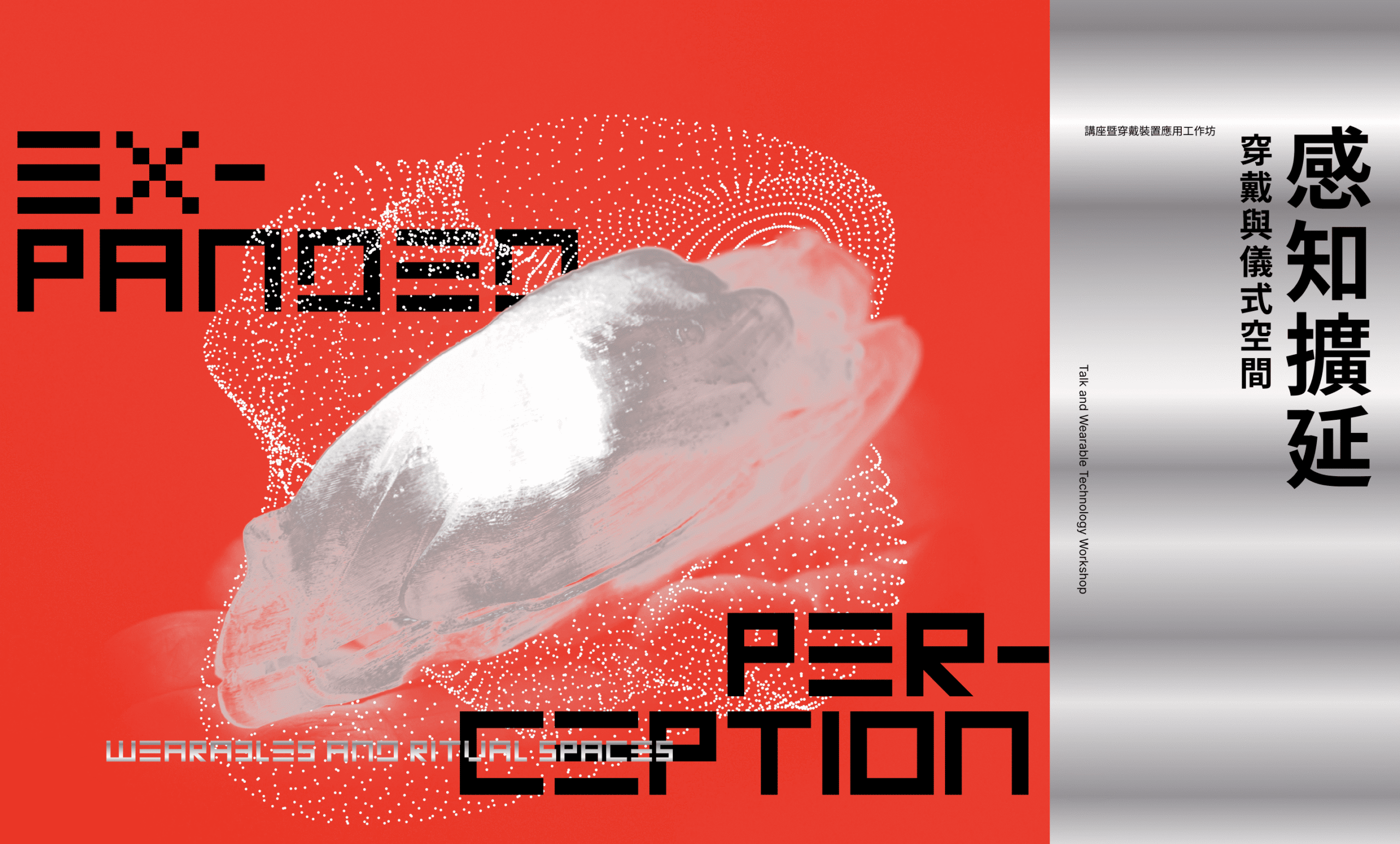
Expanded Perception: Wearables and Ritual Spaces [Talk and Wearable Technology Workshop]
Throughout human history, the amulet has served as a cultural symbol connecting the body, belief, and invisible forces. As media and technology evolve, these spiritual objects are gradually transforming into techno-ritual artifacts — hybrid forms that weave together memory, perception, and ritual. Within the context of contemporary art, the amulet is no longer merely a vessel of protection or prayer, but an interface that activates extended perception and speculative imagination, expanding our understanding of sensory experience and the interpretive possibilities of art.
This program focuses on the transformation of the amulet within new media art practices. It explores how cultural objects are reconfigured through technological mediation, shifting their symbolic and ritual dimensions. The talk segment will approach the topic from perspectives in contemporary art, media archaeology, and semiotic translation, reflecting on how amulets traverse systems of faith, the human body, and spatial environments to become new forms of digital perceptual practice. The workshop will introduce methods for crafting digital amulets through the integration of sensing components and wearable technologies, guiding participants in creating prototypes that embody visions of future perception.
We warmly invite artists, cultural practitioners, researchers, and anyone interested in new media art, symbolic culture, and speculative sensing to join us. Together, we will explore the creative potential of techno-ritual artifacts and reimagine how digital perception, memory, and ritual might take shape in the cultural futures to come.
Speaker | Yu-Hsiung Huang
Venue | 1F, Center for Art and Technology
Registration Link | https://forms.gle/XdGawgqruFXa72MF9
Contact | 02-2896-1000 #2104 or linping@gmcc.tnua.edu.tw
Speaker Introduction
Yu-Hsiung Huang
Director, Perception Interface Lab, Center for Art and Technology, TNUA
Assistant Professor, Department of New Media Art, TNUA
Yu-Hsiung Huang’s work bridges interactive technology and new media art through a transdisciplinary approach that reimagines cultural history via digital mediums and explores how interactive systems shape our presence within the digital realm. As the director of Perception Interface Lab at Center for Art and Technology and Assistant Professor in the Department of New Media Art at the National Taipei University of the Arts, he has recently focused on the poetic tensions between media technologies and the human condition. His work also draws deeply from Sci-Fi and new media studies, using AI, machine learning, code, and sensors to articulate the paradoxical and multilayered relationship between technology and contemporary life.
Notices
1. Check-in for the morning session is available from 9:30 am to 9:50 am, and for the afternoon session from 1:10 pm to 1:30 pm.
2. Priority will be given to online registrations. Please complete check-in at least 10 minutes before the event begins. Late arrivals will forfeit their reserved spot, which will be allocated to the participants registering on the day of the event in order of arrival. Seats are limited; early arrival is strongly recommended.
3. Due to the limited number of wearable devices, on-site registration will not be available for the afternoon session.
4. Each registration form corresponds to one participant. To register two individuals, please submit two separate forms with different names, and so on. (Note: If two forms are submitted with the same name and contact information, they will be treated as a single registration upon manual review.)
5. The organizer reserves the right to modify the event content and retains the final right of interpretation.
Adviser:Ministry of Education, Republic of China
Organizer:Center for Art and Technology, Graduate Institute of Arts and Humanities Education, TUNA
(This event is organized with support from the Ministry of Education’s University Aesthetic and Literacy-Oriented Preparatory Course Promotion Program.)